

What is CometBFT
CometBFT is software for securely and consistently replicating an application on many machines. By securely, we mean that CometBFT works as long as fewer than 1/3 of machines fail in arbitrary ways. By consistently, we mean that every non-faulty machine sees the same transaction log and computes the same state. Secure and consistent replication is a fundamental problem in distributed systems; it plays a critical role in the fault tolerance of a broad range of applications, from currencies to elections to infrastructure orchestration and beyond. The ability to tolerate machines failing in arbitrary ways, including becoming malicious, is known as Byzantine fault tolerance (BFT). The theory of BFT is decades old, but software implementations have only become popular recently, due largely to the success of “blockchain technology” like Bitcoin and Ethereum. Blockchain technology is just a reformalization of BFT in a more modern setting, with emphasis on peer-to-peer networking and cryptographic authentication. The name derives from the way transactions are batched in blocks, where each block contains a cryptographic hash of the previous one, forming a chain. CometBFT consists of two chief technical components: a blockchain consensus engine and a generic application interface. The consensus engine, which is based on the Tendermint consensus algorithm, ensures that the same transactions are recorded on every machine in the same order. The application interface, called the Application BlockChain Interface (ABCI), delivers the transactions to applications for processing. Unlike other blockchain and consensus solutions, which come pre-packaged with built-in state machines (like a fancy key-value store or a quirky scripting language), developers can use CometBFT for BFT state machine replication of applications written in whatever programming language and development environment is right for them. CometBFT is designed to be easy to use, simple to understand, highly performant, and useful for a wide variety of distributed applications.CometBFT vs. X
CometBFT is broadly similar to two classes of software. The first class consists of distributed key-value stores, like Zookeeper, etcd, and Consul, which use non-BFT consensus. The second class is known as “blockchain technology” and consists of both cryptocurrencies like Bitcoin and Ethereum, and alternative distributed ledger designs like Hyperledger’s Burrow.Zookeeper, etcd, Consul
Zookeeper, etcd, and Consul are all implementations of key-value stores atop a classical, non-BFT consensus algorithm. Zookeeper uses an algorithm called Zookeeper Atomic Broadcast, while etcd and Consul use the Raft log replication algorithm. A typical cluster contains 3-5 machines and can tolerate crash failures in fewer than 1/2 of the machines (e.g., 1 out of 3 or 2 out of 5), but even a single Byzantine fault can jeopardize the whole system. Each offering provides a slightly different implementation of a feature-rich key-value store, but all are generally focused on providing basic services to distributed systems, such as dynamic configuration, service discovery, locking, leader election, and so on. CometBFT is in essence similar software, but with two key differences:- It is Byzantine Fault Tolerant, meaning it can only tolerate fewer than 1/3 of machines failing, but those failures can include arbitrary behavior— including hacking and malicious attacks.
- It does not specify a particular application, like a fancy key-value store. Instead, it focuses on arbitrary state machine replication, so developers can build the application logic that’s right for them, from key-value stores to cryptocurrency to e-voting platforms and beyond.
Bitcoin, Ethereum, etc.
The Tendermint consensus algorithm, adopted by CometBFT, emerged in the tradition of cryptocurrencies like Bitcoin, Ethereum, etc., with the goal of providing a more efficient and secure consensus algorithm than Bitcoin’s Proof of Work. In the early days, Tendermint consensus-based blockchains had a simple currency built in, and to participate in consensus, users had to “bond” units of the currency into a security deposit which could be revoked if they misbehaved—this is what made Tendermint consensus a Proof-of-Stake algorithm. Since then, CometBFT has evolved to be a general-purpose blockchain consensus engine that can host arbitrary application states. That means it can be used as a plug-and-play replacement for the consensus engines of other blockchain software. So one can take the current Ethereum code base, whether in Rust, Go, or Haskell, and run it as an ABCI application using CometBFT. Indeed, we did that with Ethereum. And we plan to do the same for Bitcoin, ZCash, and various other deterministic applications as well. Another example of a cryptocurrency application built on CometBFT is the Cosmos network.Other Blockchain Projects
Fabric takes a similar approach to CometBFT, but is more opinionated about how the state is managed and requires that all application behavior runs in potentially many Docker containers, modules it calls “chaincode”. It uses an implementation of PBFT from a team at IBM that is augmented to handle potentially non-deterministic chaincode. It is possible to implement this Docker-based behavior as an ABCI app in CometBFT, though extending CometBFT to handle non-determinism remains for future work. Burrow is an implementation of the Ethereum Virtual Machine and Ethereum transaction mechanics, with additional features for a name registry, permissions, and native contracts, and an alternative blockchain API. It uses CometBFT as its consensus engine and provides a particular application state.ABCI Overview
The Application BlockChain Interface (ABCI) allows for Byzantine Fault Tolerant replication of applications written in any programming language.Motivation
Thus far, all blockchain “stacks” (such as Bitcoin) have had a monolithic design. That is, each blockchain stack is a single program that handles all the concerns of a decentralized ledger; this includes P2P connectivity, the “mempool” broadcasting of transactions, consensus on the most recent block, account balances, Turing-complete contracts, user-level permissions, etc. Using a monolithic architecture is typically bad practice in computer science. It makes it difficult to reuse components of the code, and attempts to do so result in complex maintenance procedures for forks of the codebase. This is especially true when the codebase is not modular in design and suffers from “spaghetti code”. Another problem with monolithic design is that it limits you to the language of the blockchain stack (or vice versa). In the case of Ethereum, which supports a Turing-complete bytecode virtual machine, it limits you to languages that compile down to that bytecode; while the list is growing, it is still very limited. In contrast, our approach is to decouple the consensus engine and P2P layers from the details of the state of the particular blockchain application. We do this by abstracting away the details of the application to an interface, which is implemented as a socket protocol.Intro to ABCI
CometBFT, the “consensus engine”, communicates with the application via a socket protocol that satisfies the ABCI, the CometBFT Socket Protocol. To draw an analogy, let’s talk about a well-known cryptocurrency, Bitcoin. Bitcoin is a cryptocurrency blockchain where each node maintains a fully audited Unspent Transaction Output (UTXO) database. If one wanted to create a Bitcoin-like system on top of ABCI, CometBFT would be responsible for- Sharing blocks and transactions between nodes
- Establishing a canonical/immutable order of transactions (the blockchain)
- Maintaining the UTXO database
- Validating cryptographic signatures of transactions
- Preventing transactions from spending non-existent transactions
- Allowing clients to query the UTXO database
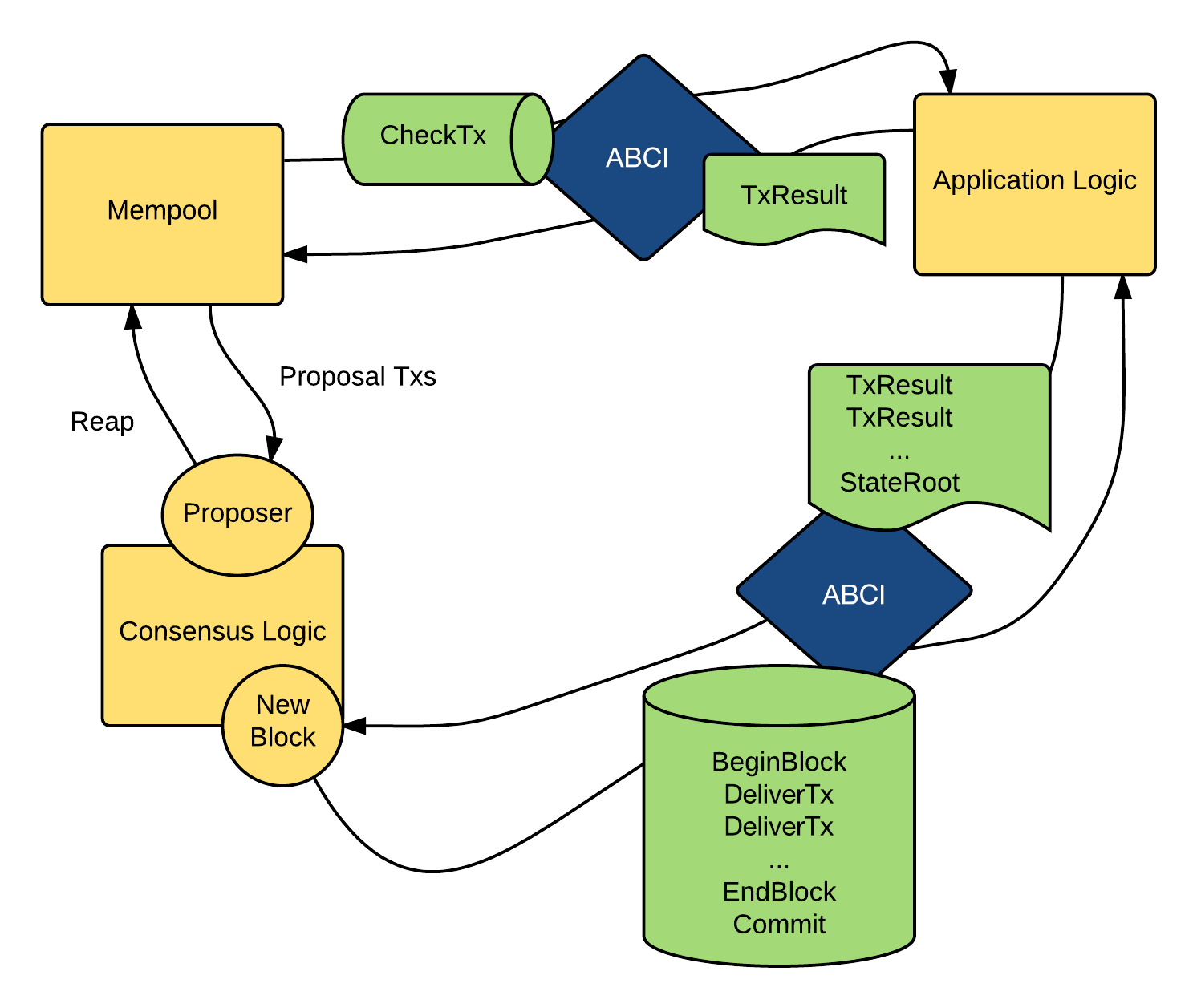
A Note on Determinism
The logic for blockchain transaction processing must be deterministic. If the application logic weren’t deterministic, consensus would not be reached among the CometBFT replica nodes. Solidity on Ethereum is a great language of choice for blockchain applications because, among other reasons, it is a completely deterministic programming language. However, it’s also possible to create deterministic applications using existing popular languages like Java, C++, Python, or Go by avoiding sources of non-determinism such as:- random number generators (without deterministic seeding)
- race conditions on threads (or avoiding threads altogether)
- the system clock
- uninitialized memory (in unsafe programming languages like C or C++)
- floating point arithmetic
- language features that are random (e.g., map iteration in Go)
Consensus Overview
CometBFT adopts the Tendermint consensus, an easy-to-understand, mostly asynchronous, BFT consensus algorithm. The algorithm follows a simple state machine that looks like this: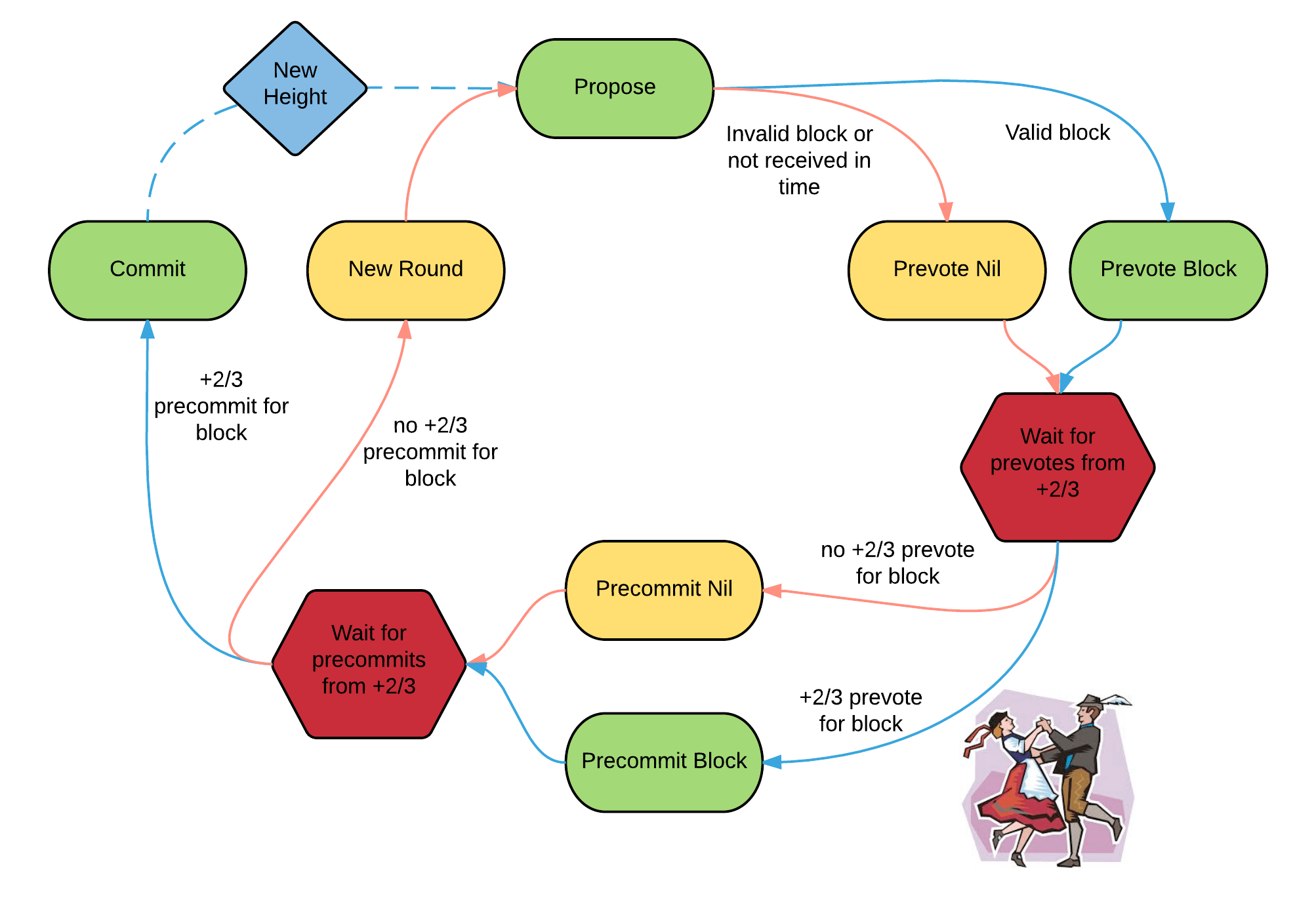
- it must prevote for the block it is locked on
- it can only unlock and precommit for a new block if there is a polka for that block in a later round